PCB Impedance Test Coupons: What They Are and Why They Matter

The-introduction-to-pcb-impedance-control-test-coupons

PCB Impedance Control: A Foundational Guide for Signal Integrity

Controlled impedance is not merely a specification—it is a fundamental requirement for reliable signal transmission in modern electronics. As digital signal speeds increase, with rise times plummeting to 1-2 nanoseconds and below, the PCB traces on a board no longer function as simple conductors but behave like transmission lines.

When the impedance of a trace is not matched to the source and load, signal reflections, overshoot, and timing errors occur. This degradation manifests as data corruption, electromagnetic interference (EMI), and system failure. Impedance control is the disciplined engineering practice of designing PCB traces to maintain a specific, target characteristic impedance—ensuring that signals are transmitted with integrity from their source to destination.

Diagram of a differential pair on a PCB, showing trace spacing and coupling for controlled impedance.
Differential Pair Routing Line
Cross-section of a single-ended microstrip trace on a PCB for controlled impedance.
Single-Ended Microstrip Transmission Line.

Achieving this requires meticulous management of several key factors:

  • Trace Geometry: Width and thickness.
  • Dielectric Material: The core and prepreg’s dielectric constant (Dk).
  • Stack-up Height: Distance between the trace and its reference plane.

By mastering these elements, designers can create robust, high-performance systems for applications ranging from high-speed digital and RF communications to advanced computing.

PCB Impedance Test Coupons: Purpose and Function

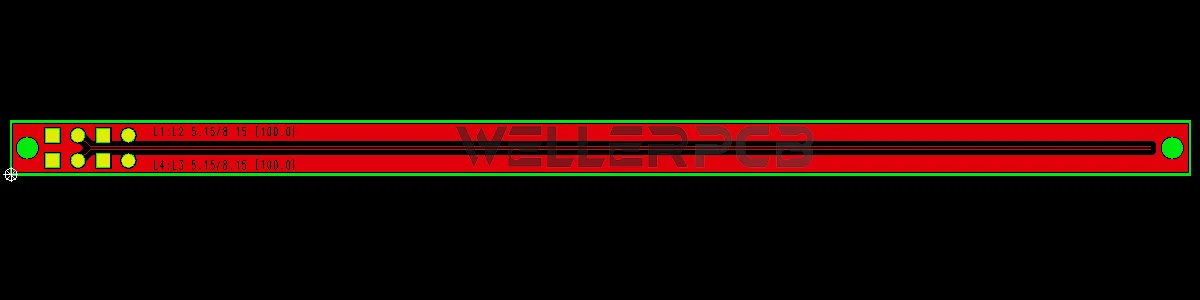
A PCB impedance test coupon is a small, dedicated section of a bare printed circuit board that contains only specific trace structures and via patterns designed for impedance measurement.

Why Are They Used?

To guarantee impedance control, these coupons are integrated into the manufacturing panel and produced simultaneously with the main PCBs using the exact same process—same materials, lamination, and etching. This ensures the coupon is a truly representative sample of the impedance-controlled traces on the actual boards.

How Are They Tested?

The coupon features conductive holes (vias) that connect to the internal impedance traces. After production, a specialized impedance tester (such as a TDR) uses probes to measure the traces through these access points. This non-destructive test validates that the manufactured PCB meets the specified impedance requirements, such as 50 or 100 ohms, which is critical for signal integrity.

PCB impedance test coupon design with critical dimensions and test point locations
PCB Impedance Test Coupon Design

Single Ended PCB Impedance Control and it's Coupons

Single-ended impedance refers to the characteristic impedance of an individual transmission line relative to its reference plane in a circuit board. This fundamental impedance control approach remains essential for numerous digital and analog circuits, providing reliable signal transmission for clock signals, general-purpose I/O, and lower-speed data interfaces where noise immunity requirements are less critical than differential pairs.

Design specifications for single-ended 50 ohm impedance test coupon on PCB
Single-Ended 50Ω Test Coupon Design

Key Specifications:
The target single-ended impedance typically maintains 50 ohms as the industry standard, with common manufacturing tolerances of ±10%. This value represents a careful balance between power handling capability and signal integrity considerations. Applications like RF circuits, DDR memory interfaces, and PCI Express references all rely on precise 50Ω impedance matching to minimize signal reflections and ensure proper operation.

Key Specifications:
Dedicated test coupons serve as crucial validation tools manufactured simultaneously with production boards. These specialized coupon designs incorporate:

  • Isolated single traces with controlled width and thickness
  • Precision-placed test points for probe attachment
  • Identical layer stack-up and dielectric materials as the main PCB
Close-up photo of a single-ended PCB impedance test coupon showing test traces and measurement points
Actual Single-Ended Impedance Test Coupon

These coupons allow manufacturers to verify impedance compliance using Time Domain Reflectometry (TDR) before shipment, ensuring proper signal integrity in the final application. The validation process confirms that all critical parameters—including trace geometry, dielectric thickness, and material properties—combine to achieve the specified impedance target.

Differential PCB Impedance Control and it's Coupons

Differential impedance refers to the characteristic impedance measured between a pair of closely coupled transmission lines on a circuit board. This paired configuration is essential for high-speed digital interfaces like USB, HDMI, and Ethernet, where it provides superior noise immunity compared to single-ended signals.

Differential pair impedance test coupon design with critical spacing and trace geometry parameters
Differential Pair Impedance Test Coupon Design

Key Specifications:
The target differential impedance typically ranges from 80 to 100 ohms, with standard manufacturing tolerances of ±10%. Common values include 90Ω for USB and 100Ω for Ethernet applications. Maintaining this impedance requires precise control over trace width, spacing, and dielectric consistency.

Verification Methodology:
Test coupons are essential validation tools fabricated alongside production boards. These specialized coupon designs feature:

  • Matched differential pair traces with controlled geometry
  • Precisely spaced test points for probe connection
  • Identical stack-up and materials as the main PCB
Actual differential impedance test coupon showing paired traces and measurement points
Actual Differential Impedance Test Coupon

These coupons enable manufacturers to verify impedance compliance using Time Domain Reflectometry (TDR) before shipping, ensuring signal integrity in the final application.

PCB Impedance Verification Using Test Coupons

Test coupons provide the most reliable method for verifying controlled impedance in PCB manufacturing. Since these coupons are fabricated on the same panel using identical materials and processes as the production boards, they accurately represent the impedance characteristics of the actual PCB traces.

PCB impedance test coupon design and manufacturing process with critical parameters
Impedance coupouns for testing and verification
Verification Process:

The validation is performed using specialized impedance test equipment, such as the Polar CITS880s. Test probes are connected to the coupon’s access points (vias) to measure the characteristic impedance of the trace structures. This non-destructive test confirms whether the manufactured impedance matches the design specifications, typically 50Ω for single-ended or 100Ω for differential pairs.

Quality Assurance:

Matching the designed impedance values is critical for proper electronic functionality after PCB assembly. Reputable PCB manufacturers include these test coupons and provide detailed impedance test reports with each shipment, ensuring transparency and quality assurance at no additional cost.

Engineer performing PCB impedance control test using TDR equipment on test coupon
PCB Impedance Testing in Progress

Related Posts

Leave a Reply

Your email address will not be published. Required fields are marked *