PCB Assembly

Firmware Burning-in and Functional Test Test

Weller delivers end-to-end electronic manufacturing services (EMS) with specialized engineering support, IPC-compliant testing, and multifunctional PCB assembly capabilities for mission-critical applications.
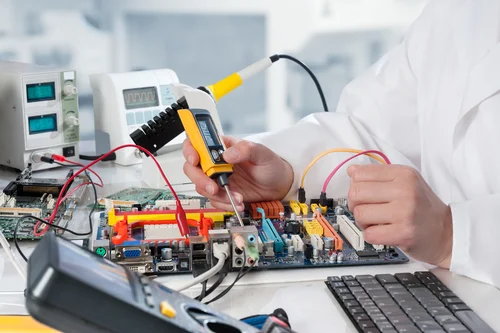
PCB assembly Functional test failure analysis

What Is A Functional Testing?

Functional testing (also known as FCT testing) is a crucial quality assurance step performed at the end of electronic product manufacturing. Testing can ensure that electronic devices operate properly. 

It is a vital quality assurance procedure that differs from AOIX-RAY and other quality inspecting methods. The testing purpose is to validate that hardware design and manufacturing is free of defects or flaws, and ensure that the product operate functionally in a system application.

This refer to test the electrical function of the populated printed circuit boards after SMT assembly, which differs the common flying probe testing that perforated in bare printed circuit boards fabrication process

How Is Functional Testing Performed?

FCT testing can range from simple type of testing like ‘red light/green light’, ‘power on/off’; and to more comprehensive sophisticated functional testing involving temperature testing, sensor testing, geospatial tracking and verification, multi-variant test output, test probe and edge connector measurements, and/or programming verification.

Typically, the power supply and the software test program will be loaded to the electronic device to make the testing work properly. Customer or electronic designer may be required to provide necessary testing specification and procedures. 

CALL US NOW

086 (0755) 2828 2776

Don’t hesitate, contact us to start discussing your projects. We prioritize your inquiries and aim to respond within 12 hours.

Except functional testing, some other testing methods are also widely used to test electrical features of populated PCB boards, below are some common ways to functionally test assembled PCB or bare printed circuit boards.

In circuit tests (ICT): It is for inspection of populated printed circuit boards, contacting with specialised needle bed adapters, many test points simultaneously (including checking circuity of each component)
Flying probe test (PBT): This test mostly used to inspect bare printed circuit boards after PCB fabrication finishing, contacting with universal flying probe testers, few test points sequentially.

Difference Between Various Testing

CALL US NOW

086 (0755) 2828 2776

The best results for you

Quick access to us

Don’t hesitate, contact us to start discussing your projects. We prioritize your inquiries and aim to respond within 12 hours.

PCB assembly Functional testing included

What Is Required For Functional Testing?

For functional testing performed in industrial environments, typically the following hardware and software is required:

A test fixture (or a test JIG): which is a type of fixture customized upon customer’s specific PCB board test points. It can be used to test bare printed circuit board or populated PCBs.

Software and firmware: Necessary software that executing the test sequences, and the firmware that programmed into MCU. The software could be a common one that compatible to same brand Chips such as ST, or it could be a customized one that uniquely designed by the PCB designer, or it could be a system software such as Linux. The firmware is to drive the MCU and drive the assembled board.

An experienced engineer: Apparently this looks simply but  very critical in all of the work, the time will be saved by skilled engineer once it comes to shot the bugs and problems in the test process.

Other particular condition required: Such as shielded test room.

CALL US NOW

086 (0755) 2828 2776

Don’t hesitate, contact us to start discussing your projects. We prioritize your inquiries and aim to respond within 12 hours.

Why Testing Is Crucial and How It Matters to You?

No matter how confident you are in your electronic design, and your contract manufacturer, functional testing is a confirmed assurance to both you and your supplier. Even a high capability and highly automatic manufacturing process factory, it is impossible to eliminate some hidden flaws such as damaged MCU by static hurts. Therefor the consistent tests can maintain manufacturer quality and guarantee your product is fit for sale.

By performing functional test for your assembled printed circuit boards, you can maintain the confidence of the quality your products. It will increase customers satisfaction, achieve reputation and establish a long-term mutual-trusted business relationship. Electrical functional testing is an essential step for PCB fabrication and printed circuit board assembly.

Functional tests can identify the typical issues like:

Power issues: Being able to power on is a premise for a PCB to function properly. Functional PCBA tests can examine power strength and point out issues with checking output voltage on some critical test points.
Signal distortion: Tests can also explore problems with signal distortion or failure during use.
Inaccurate voltage: Multiple factors could cause incorrect voltage output, from incorrect component placement to a fake chip, or missing a part entirely. A functional test can thoroughly explore these issues and let your contract manufacturer shot the problem properly.

FAQ: Firmware Programming & Functional Testing in PCB Assembly​

A typical ​​firmware programming service​​ is a critical step in the ​​PCB assembly process​​. It involves loading the pre-developed software (firmware) onto the microcontroller or memory chip on your assembled printed circuit board. Our service includes:

  • ​​Secure File Handling:​​ We accept your firmware file in various formats (e.g., .hex, .bin) and manage it with strict version control and NDAs.
  • In-Circuit Programming:​​ We program the chips directly on the assembled board using ​​programming fixtures​​ (bed-of-nails) or pogo-pin testers, which allows for high-speed, automated programming.
  • Post-Programming Verification:​​ After loading, we automatically verify the checksum or hash of the programmed firmware to ensure completeness and accuracy.
  • ​​Integration with ICT/FCT:​​ Programming is often integrated with ​​In-Circuit Testing (ICT)​​ and ​​Functional Circuit Testing (FCT)​​ for a seamless production flow.​
Functional Testing (FCT)​​ is absolutely necessary because it simulates the real-world operating environment of your product. While ​​firmware programming​​ ensures the software is present, FCT confirms it works correctly with the hardware. It is the ultimate ​​quality control​​ check to:

  • ​​Validate System Operation:​​ Verify that the PCB performs its intended functions (e.g., sensors read accurately, motors turn on, displays show correct data).
  • ​​Catch Integration Bugs:​​ Identify issues that only appear when the firmware interacts with all the assembled components.
  • ​​Ensure Customer Satisfaction:​​ Ship products that power on and work as expected right out of the box, reducing returns and support costs.
Yes, absolutely. In modern, automated ​​PCB assembly​​ lines, we often combine ​​firmware programming​​ and ​​functional testing​​ into a single, efficient step. This is achieved through a custom ​​automated testing system​​ (a “test fixture”).

  • ​​The Process:​​ The PCB is placed in the fixture, which makes electrical contact. The system first programs the firmware, verifies it, and then immediately powers up the board to run a suite of ​​functional tests​​.
  • ​​Benefits:​​ This combined approach, a form of ​​end-of-line testing​​, significantly reduces handling time, minimizes the risk of damage, and accelerates overall production throughput while ensuring comprehensive validation.

To provide an accurate ​​PCB assembly quote​​ and set up the programming and testing, we require the following:

  • ​​For Firmware Programming:​​ The final firmware file, target microcontroller specifications, communication protocol (e.g., JTAG, SWD, UART), and any required programming algorithms.
  • ​​For Functional Testing:​​ A detailed test plan or specification outlining the pass/fail criteria for each function. Even better, we can collaborate with your team on ​​test plan development​​ and help you design a custom ​​functional test fixture.


A comprehensive test procedure document—detailing all required tools, steps and checklists—is essential for consistent results. Use this downloadable template as a reference to create your formal test instruction document.

As an experienced ​​contract manufacturer​​, we take the security of your intellectual property (IP) extremely seriously. We protect your firmware through:

  • ​​Strict NDAs:​​ All employees sign comprehensive Non-Disclosure Agreements.
  • Secure Data Transfer:​​ Use of encrypted channels for all file transfers.
  • ​​Controlled Access:​​ Firmware files are stored on secure, access-controlled servers and are purged from programming equipment after the production run, as per your requirements.
  • ​​Audit Trails:​​ We maintain logs of who accessed the firmware and when.
Both ICT and FCT are crucial for ​​PCB inspection​​, but they serve different purposes:

  • In-Circuit Test (ICT):​​ This is a ​​manufacturing defects​​ test. It checks for assembly errors like short circuits, open circuits, incorrect component values, or missing parts. It is a structural test that typically occurs beforefirmware is loaded.
  • ​​Functional Circuit Test (FCT):​​ This is a system-level test. It powers up the assembled and programmed PCB to verify that the entire product functions as a whole according to its design specifications. ​​FCT​​ confirms that the hardware and ​​firmware​​ work together correctly.

What You Can Rely On From WELLER

With 10+ years experience in electronic manufacturing filed on serving a varied group of customers, we have accumulated a much wider arsenal of engineering knowledge, technology experience and filed expertise than common OEM customers.  Therefor, you can rely on WELLER as your trusted EMS provider including PCB fabrication, SMT assembly and final testing.

OEM customers or electronic designers can benefit greatly by working with us. The main reasons is that we are a knowledgeable, experienced, and savvy EMS provider draws from our past experience base and makes valuable suggestions relating to different reliability techniques and standards. We have experienced test engineers professional in programming and problem debugging for various of brand Chips, Atmel, ST, TI, Xilinx, Qualcomm, etc. Our experienced testing projects including multiple application fields, such as IOT, medical, defence, etc. Consequently, WELLER is perhaps in the best position to help you evaluate your test options and suggest the best test methods to improve product performance, manufacturability, quality, reliability, and most crucial, cost.