In the ENEPIG vs ENIG decision, a controlled ENIG process is sufficient for many conventional SMT assemblies. ENEPIG becomes more useful when wire bonding, mixed interconnection methods, or defined product requirements make the palladium layer valuable.
ENEPIG vs ENIG at a Glance
The correct choice depends on assembly, bonding, qualification, and supplier process control—not on finish complexity alone.
ENIG vs ENEPIG: Core Engineering Differences
Palladium is the key difference| Selection Factor | ENIG | ENEPIG |
|---|---|---|
| Metal stack | Ni → Au | Ni → Pd → Au |
| Conventional SMT | Suitable | Suitable |
| Fine-pitch packages | Suitable with process control | Suitable |
| Wire bonding | Process-dependent | Broader flexibility |
| Process complexity | Lower | Higher |
| Relative cost | Generally lower | Generally higher |
| Evaluate first when | Flat solderable finish is sufficient | Palladium supports a defined requirement |
Selection principle: Choose ENEPIG for a defined bonding, mixed-assembly, or qualification requirement—not simply because the PCB is complex.
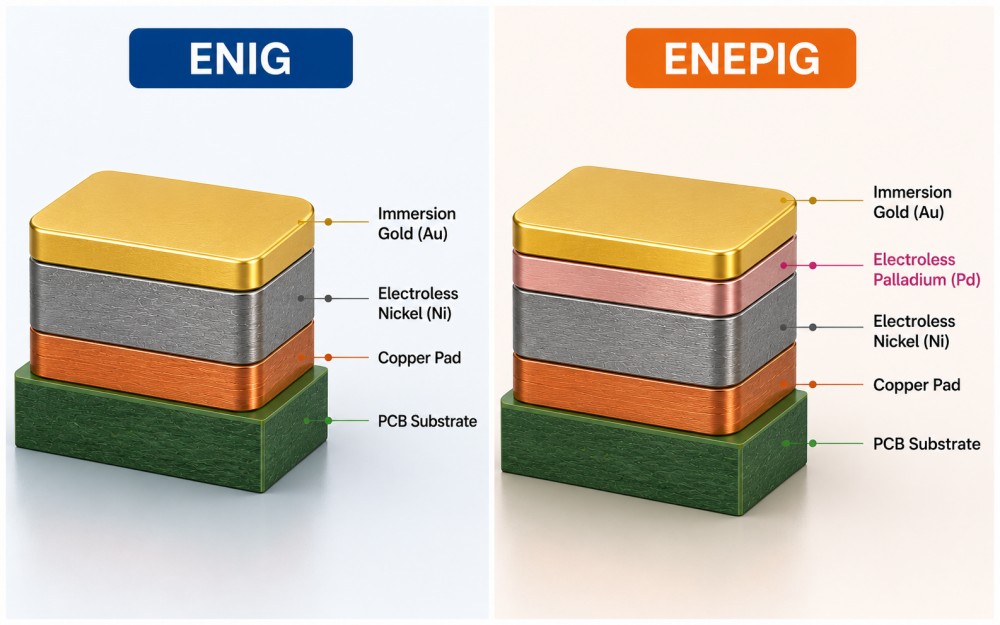
ENEPIG vs ENIG Layer Structure

Surface Finish Layer Structure
Key difference: ENEPIG adds a palladium barrier between the nickel and gold layers.
ENIG Uses a Nickel-Gold Stack
The nickel acts as the barrier over copper, while the thin immersion-gold layer protects the nickel surface before soldering.
ENEPIG Adds a Palladium Layer
Palladium separates the nickel from the immersion-gold layer and can provide a more suitable interface for selected bonding and mixed-assembly processes.
ENEPIG vs ENIG for SMT and Fine-Pitch Assembly

Both finishes provide flat pads for PCB assembly. For SMT, the choice should follow the joining process and qualification plan rather than package pitch alone.
SMT and Fine-Pitch Assembly
Both ENIG and ENEPIG provide flat pads suitable for BGA, QFN, CSP, and LGA assembly. For an SMT-only board, a qualified ENIG process is often sufficient.
Evaluate pad geometry, solder-mask definition, paste selection, reflow conditions, and supplier capability before changing the surface finish.
Mixed Assembly Can Change the Decision
Wire Bonding and Mixed Interconnection
Wire bonding is one of the strongest reasons to evaluate ENEPIG, especially when soldering and bonding must coexist on the same PCB.
Gold Wire Bonding Is a Strong Reason to Evaluate ENEPIG
ENEPIG is commonly evaluated for gold wire bonding because its Ni/Pd/Au structure provides a different bonding interface from standard ENIG. Final suitability still depends on the wire, bond-pad design, deposit condition, and qualified assembly process.
ENIG Is Not Universally Unsuitable for Wire Bonding
- Bond-wire material and bonding method
- Bond-pad geometry and surface requirements
- Assembly-house process qualification
- Required bond testing or inspection
ENEPIG vs ENIG: Reliability and Process Control
Reliability depends on surface preparation, plating chemistry, deposit control, storage, and assembly—not on the finish name alone.
Black Pad Is a Process Risk

Black pad is associated with abnormal corrosion of the electroless-nickel surface during ENIG processing. ENEPIG changes the interface above the nickel by adding palladium, but it is not immune to plating, soldering, or bonding defects.
Process Control Matters More Than Marketing Labels
- Stable plating chemistry and clean surface preparation
- Consistent nickel, palladium, and gold deposits
- Controlled deposit thickness
- Documented inspection and measurement methods
XRF and Finish Verification
XRF provides non-destructive verification of plated-metal thickness and composition. It should be combined with solderability, bond, visual, or microsection checks when those risks apply to the product.
Surface Finish Verification Matrix
Match Evidence to Risk| Method | What It Confirms | What It Does Not Confirm |
|---|---|---|
| XRF Measurement | Metal thickness and composition | Solder-joint or bond reliability |
| Visual Inspection | Surface appearance and visible defects | Internal interface condition |
| Solderability Test | Wetting performance under defined conditions | Wire-bond performance |
| Bond Qualification | Bond strength for the selected process | All future materials and settings |
| Process Records | Bath control and production traceability | Product-level performance by themselves |
Verification rule: use the evidence method that matches the actual assembly, bonding, reliability, or compliance risk.
Specification Reference
| Finish | Metal Stack | IPC Reference |
|---|---|---|
| ENIG | Ni / Au | IPC-4552B |
| ENEPIG | Ni / Pd / Au | IPC-4556 series |
Cost, Fabrication Notes, and Supplier Checks
Cost is an important part of the ENEPIG vs ENIG comparison. ENEPIG generally costs more because it adds palladium and another controlled deposition step, although the actual premium depends on finish area, quantity, supplier process route, and inspection requirements.
What Drives ENEPIG Cost
- Additional palladium deposition
- Precious-metal consumption
- Additional process control and handling
- Supplier availability and reporting requirements
Prototype pricing may differ from repeat production because setup, outsourcing, minimum lot requirements, and process availability can affect the quote. Avoid applying a fixed percentage premium from another supplier to every project.

Make the Fabrication Callout Clear
A controlled fabrication drawing should identify the selected finish and any project-specific bonding, thickness, inspection, or reporting requirements. Avoid generic notes such as “gold finish.”
A DFM review before PCB manufacturing identifies conflicts involving pad geometry, solder mask, via structures, and downstream assembly.
Surface Finish Drawing Callout
Pre-Release CheckENIG or ENEPIG
State the required IPC specification and revision.
Define nickel, palladium, and gold limits where required.
Identify wire-bond material, location, and qualification need.
Specify XRF, visual inspection, or additional verification.
Note selective plating, mixed finishes, or customer limits.
Avoid vague callouts: the finish name alone may not define thickness limits, bonding expectations, or verification requirements.
Supplier Checks Before Production
| What to Confirm | Why It Matters |
|---|---|
| Specification and revision | Reduces ambiguity in finish requirements |
| In-house or outsourced finishing | Clarifies process ownership and traceability |
| Deposit measurement capability | Supports controlled thickness verification |
| Bonding-process qualification | Important for wire-bond applications |
| Inspection documentation | Supports controlled production review |
| Prototype-to-production alignment | Reduces process changes during scale-up |
ENEPIG vs ENIG: Which Finish Should You Choose?
Choose the finish that the complete fabrication, assembly, inspection, and qualification flow can control.
ENIG or ENEPIG: Selection Guide
Start With the RequirementWhich surface finish best matches the complete fabrication and assembly process?
Conventional SMT Requirement
- Flat solderable pads are required
- No defined wire-bond requirement
- Fabricator has a qualified ENIG process
- Lower process complexity is preferred
Bonding or Mixed-Assembly Requirement
- Wire bonding is part of the assembly flow
- Soldering and bonding share the same PCB
- Palladium supports a defined interface need
- A customer specification requires ENEPIG
Final check: confirm deposit requirements, inspection methods, bonding qualification, supplier capability, and total production cost before releasing the finish specification.
Avoid These Selection Shortcuts
- Choosing ENEPIG only because the board is complex or fine-pitch.
- Claiming that ENIG cannot support any wire-bond process.
- Treating ENEPIG as protection against every plating defect.
- Releasing the finish before confirming assembly and supplier requirements.