In the intricate world of PCB design and manufacturing, the surface finish is far more than just a final coating. It is the critical interface between the bare copper of your board and the components that will be soldered onto it. Choosing the wrong finish can lead to a cascade of problems—from poor solder joints and signal loss to complete board failure.
So, how do you navigate the myriad of options to select the perfect surface finish for your project? This ultimate guide breaks down everything you need to know, comparing the most common finishes across key performance metrics to empower you to make an informed decision.
Why the PCB Surface Finish Matters
So, how do you navigate the myriad of options to select the perfect surface finish for your project? This ultimate guide breaks down everything you need to know, comparing the most common finishes across key performance metrics to empower you to make an informed decision.
The primary role of a surface finish is to protect the exposed copper circuitry from oxidation and contamination, which can severely hinder solderability. However, its impact goes much further:
- Solderability: Ensures a strong, reliable metallurgical bond during PCB assembly.
- Signal Integrity: Affects electrical performance, especially in high-frequency and high-speed designs.
- Durability: Protects the board from environmental factors like humidity and heat.
- Assembly Yield: A poor finish can lead to tombstoning, voiding, and other assembly defects.
Key Decision Factors: Your Selection Checklist
Before diving into the types of finishes, use this checklist to define your project’s requirements:
- Cost: What is your budget for the finish?
- Application & Environment: Will the PCB be in a consumer device, an automotive system, or a medical implant?
- Component Types: Are you using fine-pitch BGAs or QFNs?
- Shelf Life: How long does the board need to sit before assembly?
- Signal Requirements: Is it a high-speed digital or high-frequency RF board?
- RoHS & Environmental Compliance: Does your project require lead-free processes?
A Comparative Analysis of Common PCB Surface Finishes
Here’s a detailed look at the most widely used PCB surface finishes today.
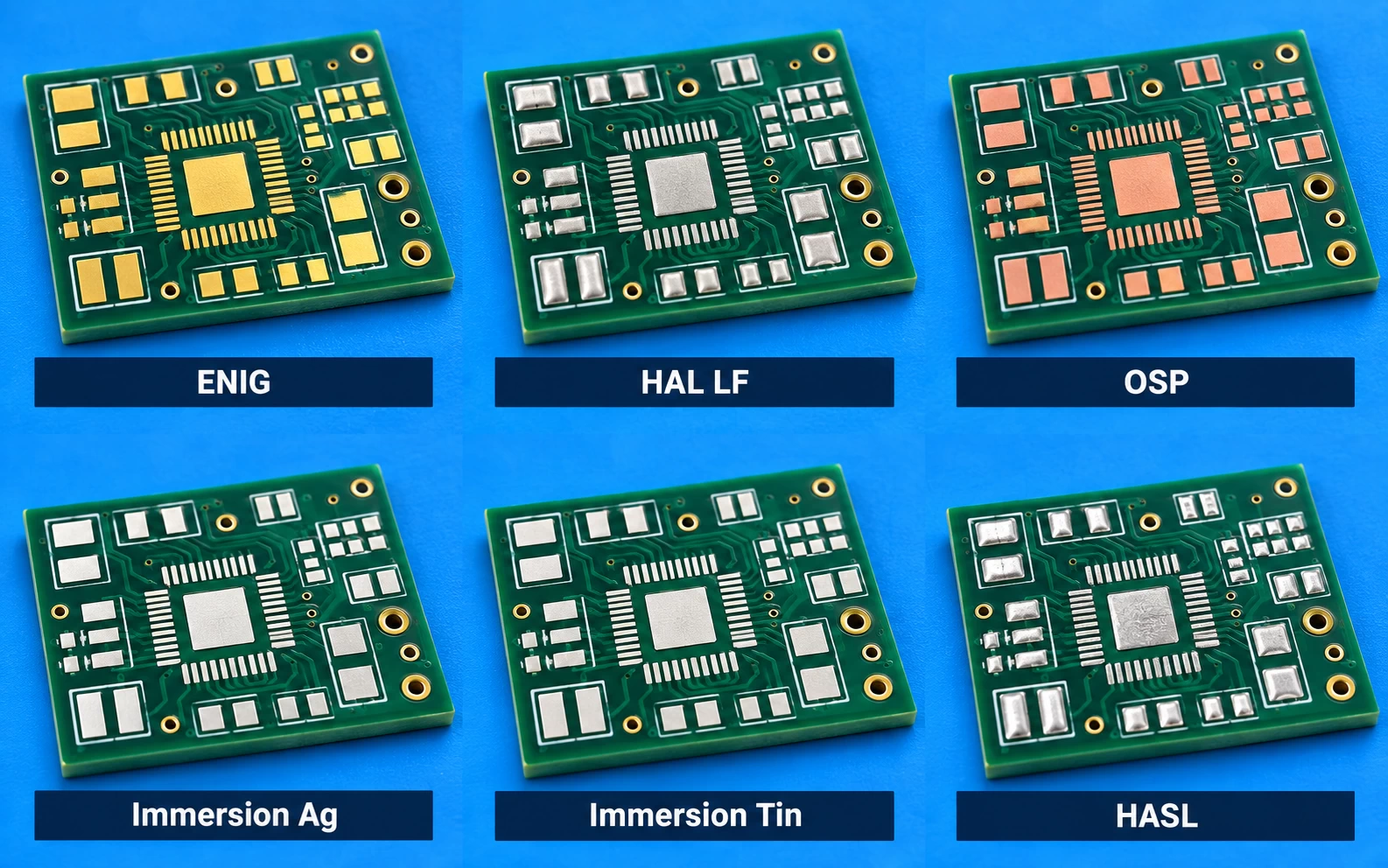
1. HASL (Hot Air Solder Leveling)
- Description: The traditional finish. The board is dipped in molten solder (lead-free or leaded) and then hot air knives level the surface.
- Pros: Very low cost, excellent solderability, long-established and well-understood process.
- Cons: Poor planarity (not suitable for fine-pitch components), thermal shock during process, can lead to solder bridging.
- Best For: Low-cost consumer electronics, simple boards with large components, prototypes where cost is the primary driver.

2. ENIG (Electroless Nickel Immersion Gold)
-
Description: A two-layer finish: a layer of nickel is plated onto the copper, followed by a thin layer of gold.
-
Pros: Excellent planarity (flat surface), good for fine-pitch components, long shelf life, robust against multiple reflow cycles.
-
Cons: Higher cost than HASL, risk of “Black Pad” syndrome (a brittle nickel-phosphorus layer that causes solder joint failure), signal loss at very high frequencies due to the nickel.
-
Best For: A versatile “default” choice for complex boards with BGAs, touch interfaces, and mid-range high-frequency applications.

3. OSP (Organic Solderability Preservative)
- Description: A water-based organic layer that bonds to the copper, preventing oxidation until soldering.
- Pros: Extremely flat surface, very low cost, simple and environmentally friendly process.
- Cons: Limited shelf life (typically 6-12 months), delicate surface that can be damaged by handling, requires specific assembly processes, inspection can be difficult.
- Best For: High-volume consumer products with quick turnaround (e.g., computers, smartphones), large copper areas requiring even coating.

4. Immersion Silver (ImAg)
Description: A thin layer of silver is deposited onto the copper through a chemical displacement reaction.
Pros: Excellent planarity, very good signal performance for high-frequency applications, no nickel layer to cause skin effect issues.
Cons: Prone to tarnishing if not stored correctly (requires anti-tarnish packaging), can cause micro-voiding in solder joints under specific conditions.
Best For: High-speed digital and RF applications, press-fit connectors, aluminum wire bonding.

5. Immersion Tin (ImSn)
Description: A metallic white finish applied through a chemical displacement reaction, where a thin layer of tin deposits onto the copper surface. It provides a flat, solderable surface that is very similar to the base material used in soldering.
Pros: Excellent planarity, comparable to silver and OSP, making it suitable for fine-pitch components. Good solderability. It is a cost-effective alternative to ENIG for applications requiring a flat surface.
Cons: Susceptible to tin whisker growth, which can cause short circuits in high-reliability applications. Has a limited shelf life (typically around 6-12 months) as the tin can continue to react with the underlying copper, eventually harming solderability. The surface is also soft and can be easily scratched during handling.
- Best For: Fine-pitch Surface Mount Technology (SMT) applications where planarity is critical but ENIG is too costly. Also suitable for press-fit applications, though it requires careful process control to mitigate whiskering risks. Commonly used in consumer electronics and certain automotive applications where the assembly cycle is short.

6. ENEPIG (Electroless Nickel Electroless Palladium Immersion Gold)
Description: An enhancement of ENIG, adding a thin layer of palladium between the nickel and gold.
Pros: Eliminates the risk of Black Pad, suitable for both solder and gold wire bonding, excellent planarity and shelf life. Often called the “universal finish.”
Cons: The highest cost of all standard finishes, a more complex process requiring tight control.
Best For: Advanced packaging, flexible PCBs, military/aerospace, and medical applications where absolute reliability is critical.

A Comparative Analysis of Common PCB Surface Finishes
Use this quick-reference table to guide your choice:
| Application Scenario | Recommended Finish(s) | Reasoning |
|---|---|---|
| Cost-Sensitive Consumer Goods | OSP, HASL | Lowest cost while meeting functional requirements. |
| Complex Boards with BGAs & Fine Pitch | ENIG, Immersion Silver | Flat surface is essential for reliable solder joints. |
| High-Frequency / RF Boards | ENIG, ENEPIG | High reliability and resistance to multiple thermal cycles. |
| Gold Wire Bonding | ENEPIG | The palladium layer is essential for a reliable bond. |
| Rigid-Flex or HDI PCBs | ENIG, ENEPIG | Provides the durability and planarity these complex boards require. |
| Quick-Turn Prototypes | HASL, ENIG | Widely available and fast to process. |
| Automotive & Harsh Environments | ENIG, ENEPIG | High reliability and resistance to multiple thermal cycles. |
| Fine-Pitch SMT on a Budget | Immersion Tin, OSP | Provides the necessary planarity for fine-pitch components at a lower cost than ENIG. |
PCB Surface Finishes: A Comparative Overview
| Surface finish | Cost | Shelf life (months) | Solderability | Corrosion resistance | Use cases |
|---|---|---|---|---|---|
| Organic solderability preservative (OSP) | Very low | 6 | Excellent | Fair | Best for lead-free assembly and quick-turn boards. |
| Hot air solder leveling (HASL) | Low | 3–6 | Good | Moderate | Works well for general-purpose and low-cost PCB boards. Not ideal for SMT due to its uneven surface. |
| Immersion silver (ImAg) | Medium | 6–12 | Excellent | Fair | Great for RF and high-frequency applications. |
| Immersion tin (ImSn) | Medium | 6–12 | Good | Fair | Suitable for circuit boards with fine-pitch components and short-term storage. |
| Electroless Nickel Immersion Gold (ENIG) | High | 12+ | Excellent | Excellent | Ideal for fine-pitch BGAs and high-speed circuit boards. |
| Electroless Nickel Electroless Palladium Immersion Gold (ENEPIG) | High | 12+ | Excellent | Excellent | Perfect for HDI designs, gold wire bonding, and applications sensitive to black pad issues. |
Conclusion: Making an Informed Decision for Your PCB
There is no single “best” PCB surface finish—only the best one for your specific design, budget, and performance requirements. By understanding the trade-offs between cost, performance, and reliability, you can move beyond a default choice and select a finish that optimizes your board’s manufacturability and end-use performance.
Ready to discuss the ideal surface finish for your next PCB project? Our engineering team is here to help you navigate these critical decisions and ensure your boards are built for success. Contact us today for an expert consultation and quote.