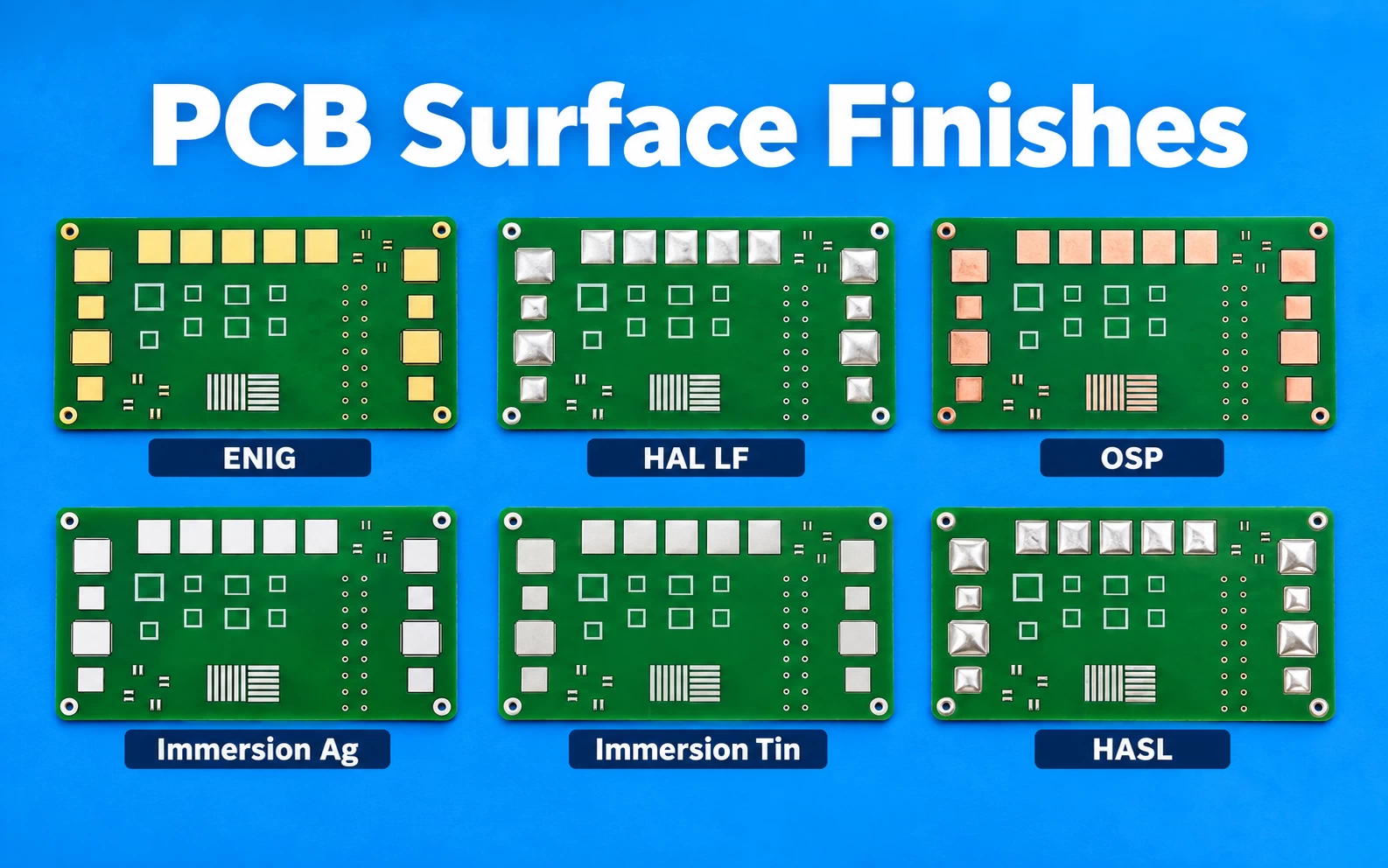
PCB surface finishes protect exposed copper pads and help ensure reliable soldering performance in electronic assemblies. Printed Circuit Boards (PCBs) are used in a wide range of products, including consumer electronics, industrial controllers, and medical systems. Since exposed copper oxidizes quickly when exposed to air, a suitable surface finish is required to maintain solderability and long-term PCB reliability.
Choosing the right surface finish requires balancing technical and production requirements. Engineers must consider factors such as cost, performance, shelf life, reliability, and compatibility with modern components including BGAs and fine-pitch devices. A finish suitable for a low-cost product may not meet the requirements of aerospace, medical, or high-speed electronic applications.
Why PCB Surface Finishes Matter
- Solderability during assembly
- Protection against copper oxidation
- Shelf life of bare PCBs
- Compatibility with fine-pitch components
- Reliability under thermal cycling
- Signal performance in high-speed designs
- Manufacturing cost
As PCB designs become smaller and more complex, the choice of finish becomes increasingly important. Modern HDI (High-Density Interconnect) boards and BGA packages require flat, uniform surfaces for reliable solder joints. Older finishes that worked well for through-hole designs may struggle in these applications.
Main Types of PCB Surface Finishes
- HASL (Hot Air Solder Leveling)
- Lead-Free HASL
- ENIG (Electroless Nickel Immersion Gold)
- ENEPIG (Electroless Nickel Electroless Palladium Immersion Gold)
- OSP (Organic Solderability Preservative)
- Immersion Silver
- Immersion Tin
HASL (Hot Air Solder Leveling)
HASL is one of the oldest and most commonly used PCB surface finishes. In this process, the PCB is dipped into molten solder, and excess solder is removed with hot-air knives. The result is a protective solder coating on exposed copper pads.
-
PCB Preparation
Clean exposed copper pads before applying the surface finish.
-
Molten Solder Coating
The PCB passes through molten solder to cover exposed copper areas.
-
Hot Air Leveling
Hot-air knives remove excess solder and create a more uniform coating.
-
Finished HASL Surface
The solder coating protects copper pads and supports PCB assembly.

Advantages of HASL
- Low manufacturing cost
- Excellent solderability
- Long industry history and proven reliability
- Suitable for multiple soldering cycles
- Good for through-hole assembly
Limitations of HASL
- Uneven surface planarity
- Not ideal for fine-pitch components
- Can create bridging issues in dense layouts
- High thermal stress during manufacturing
The biggest disadvantage of HASL is its uneven surface. Since molten solder remains on the pads, the finish may not be perfectly flat. This becomes problematic when assembling BGAs, QFNs, and small SMD components.
- Industrial electronics
- Consumer products
- Educational projects
- Low-cost PCB designs
- Through-hole dominant boards
ENIG (Electroless Nickel Immersion Gold)
Advantages of ENIG
- Extremely flat surface
- Excellent for fine-pitch components
- Good shelf life
- Suitable for BGA packages
- Strong corrosion resistance
- Attractive appearance
Disadvantages of ENIG
- Higher cost than HASL or OSP
- Complex manufacturing process
- Risk of “black pad” defects if process control is poor
- Smartphones
- Telecommunications equipment
- Medical electronics
- Automotive electronics
- High-density consumer devices
Improper nickel corrosion during ENIG processing can cause weak solder joints. Strict process control is required to minimize this risk in high-reliability applications.

ENEPIG (Electroless Nickel Electroless Palladium Immersion Gold)
Advantages of ENEPIG
- Excellent solderability
- Very reliable under multiple thermal cycles
- Ideal for wire bonding
- Excellent flatness
- Reduced black pad concerns
- Better performance in RF and high-speed applications
Disadvantages of ENEPIG
- Very expensive
- Limited availability
- More complex manufacturing process
ENEPIG is mainly used in high-reliability industries such as:
- Aerospace
- Defense systems
- Advanced RF modules
- Medical equipment
- Semiconductor packaging
OSP (Organic Solderability Preservative)
Advantages of OSP
- Very low cost
- Flat surface for fine-pitch components
- Environmentally friendly
- Simple manufacturing process
Disadvantages of OSP
- Limited shelf life
- Sensitive to handling
- Limited resistance to repeated reflow cycles
- Difficult visual inspection
- Consumer electronics
- High-volume manufacturing
- Cost-sensitive products
- Simple SMT assemblies
Immersion Silver
Advantages
- Excellent flatness
- Good conductivity
- Suitable for RF and high-speed circuits
- Lead-free process
Disadvantages
- Sensitive to tarnishing
- Requires careful handling
- Limited shelf life
- Packaging requirements are stricter
Immersion Tin
Advantages
- Good flatness
- Good solderability
- Suitable for fine-pitch components
- Better environmental profile than some alternatives
Disadvantages
- Sensitive to handling
- Possible tin whisker concerns
- Limited shelf life
- Sensitive to sulfur contamination

Comparison of Common PCB Surface Finishes
| Surface Finish | Cost | Surface Flatness | Fine-Pitch Support | Reliability | Typical Applications |
|---|---|---|---|---|---|
| HASL | Low | Moderate | Limited | Good | Industrial and low-cost products |
| Lead-Free HASL | Low-Medium | Moderate | Limited | Good | RoHS-compliant electronics |
| ENIG | Medium-High | Excellent | Excellent | Very Good | HDI boards and advanced electronics |
| ENEPIG | High | Excellent | Excellent | Outstanding | Aerospace, defense, medical systems |
| OSP | Very Low | Excellent | Excellent | Moderate | High-volume consumer electronics |
| Immersion Silver | Medium | Excellent | Excellent | Very Good | RF and high-speed circuits |
| Immersion Tin | Medium | Excellent | Excellent | Good | Fine-pitch SMT assemblies |
Factors to Consider When Choosing a Surface Finish
- Fine-pitch or BGA components: Choose flat finishes such as ENIG, ENEPIG, OSP, or Immersion Silver for advanced component packages.
- Cost-sensitive products: HASL and OSP provide economical options for applications where budget is a key consideration.
- High reliability applications: ENIG and ENEPIG are commonly selected when long-term reliability and performance are critical.
- Multiple soldering cycles: Consider finishes with better thermal stability when assemblies require repeated soldering processes.
- Long storage requirements: Select finishes with stronger oxidation protection and longer shelf life performance.
Trends in PCB Surface Finishes
- Increased use of ENIG in consumer electronics
- Growth of ENEPIG for advanced semiconductor packaging
- Declining use of leaded HASL due to environmental regulations
- Rising demand for finishes suitable for RF and high-speed systems
- Greater emphasis on environmentally friendly manufacturing