In the demanding world of electronic manufacturing, printed circuit board (PCB) protection is paramount for ensuring long-term reliability and performance. Potting resins have emerged as a critical solution for safeguarding electronic assemblies against environmental challenges. At Weller PCB, we specialize in advanced potting techniques that extend the lifespan and enhance the durability of electronic devices.
What Are PCB Potting Resins?
PCB potting resins are specialized compounds that completely encapsulate electronic components and circuits, forming a protective barrier against external threats. Unlike conformal coatings that provide surface-level protection, potting compounds fully immerse components, creating a solid, protective block that offers comprehensive defense.
These thermosetting polymers transform from liquid to solid states through chemical reactions, creating durable, protective shells around delicate electronic components.
Key Benefits of Potting in Electronic Assembly
1. Enhanced Environmental Protection
Potting resins provide exceptional resistance to:
Moisture and humidity prevention
Chemical corrosion from solvents and oils
Dust and contaminant ingress
Fungal growth in humid conditions
2. Superior Mechanical Strength
Vibration and shock absorption
Stress relief for delicate components
Impact resistance for rugged applications
Structural reinforcement for entire assemblies
3. Improved Electrical Performance
High dielectric strength for electrical insulation
Thermal management and heat dissipation
Prevention of corona discharge
Reduced electromagnetic interference (EMI)
Types of Potting Resins for PCB Assembly
Epoxy Resins
Epoxy compounds offer excellent mechanical strength and chemical resistance, making them ideal for harsh environment applications.
Advantages:
Superior adhesion to most substrates
High temperature resistance (up to 200°C)
Excellent moisture barrier properties
Good chemical resistance
Silicone Resins
Silicone potting compounds provide exceptional flexibility and thermal stability, perfect for applications requiring thermal cycling tolerance.
Advantages:
Wide temperature range (-50°C to 200°C)
Excellent UV and ozone resistance
Superior flexibility and stress relief
Good electrical insulation properties
Polyurethane Resins
Polyurethane compounds offer good moisture resistance and flexibility, suitable for applications requiring vibration damping.
Advantages:
Good low-temperature flexibility
Excellent moisture resistance
Superior abrasion resistance
Good dielectric properties
Critical Applications of PCB Potting
Automotive Electronics:
Engine control units (ECUs)
Sensor modules
Lighting systems
Industrial Equipment:
Motor drives and controllers
Power supplies
Control systems
Consumer Electronics:
Power tools
Outdoor equipment
Wearable devices
Aerospace and Defense:
Avionics systems
Military communications
Navigation equipment
Weller PCB's Potting Expertise
At Weller PCB, we understand that successful potting requires precise material selection and application techniques. Our comprehensive approach ensures optimal results:
Material Selection Guidance
Our engineering team analyzes your specific requirements to recommend the ideal potting compound based on:
Operating environment conditions
Thermal management needs
Mechanical stress factors
Regulatory compliance requirements
Cost-effectiveness consideration
Advanced Application Techniques
We employ state-of-the-art potting equipment and processes:
Vacuum potting for bubble-free encapsulation
Precise metering for consistent results
Controlled curing for optimal properties
Quality verification through testing and inspection
Best Practices for PCB Potting Success
Design Considerations
Incorporate adequate clearance for potting material flow
Design proper venting channels for air escape
Select compatible component materials
Consider thermal expansion coefficients
Process Optimization
Ensure thorough cleaning before potting
Maintain precise temperature control
Implement proper mixing and degassing
Follow recommended curing schedules
Common Challenges and Solutions
Air Entrapment:
Solution: Implement vacuum degassing during application
Prevention: Design proper flow paths and venting
Incomplete Coverage:
Solution: Optimize viscosity and flow characteristics
Prevention: Use appropriate fixturing and positioning
Thermal Management Issues:
Solution: Select thermally conductive compounds
Prevention: Incorporate heat dissipation design elements
What is Conformal Coating and Potting Resin?
Conformal coating is a thin, protective polymer film—typically 25–75µm (50µm on average, up to 100µm)—that conforms to the contours of a printed circuit board. It shields PCB assemblies from harsh operating conditions, including high humidity, airborne contaminants, and extreme temperature fluctuations. We provide professional conformal coating services using high-performance materials such as DCA200H and AFA20.
Potting resin involves encapsulating an entire electronic assembly in a solid or gel-like compound. This process enhances resistance to shock and vibration while preventing moisture ingress and corrosion. We offer a wide range of potting and encapsulation solutions, including epoxy, polyurethane, and silicone formulations, tailored to diverse application needs. Our potting services utilize reliable materials such as 3M-DP270 and EPIC S7302.
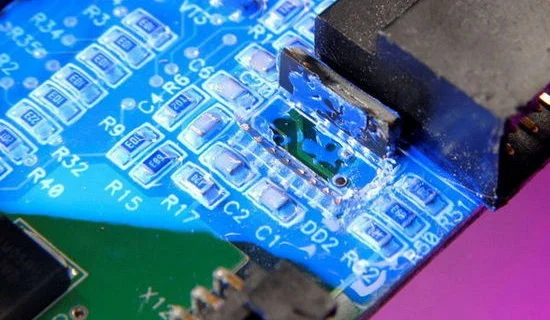
Automated selective conformal coating application using acrylic resin for superior environmental protection of automotive control modules.
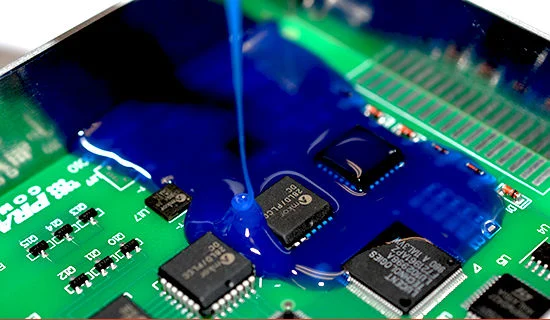
Precision pouring of thermal conductive epoxy resin into power electronics PCB assembly, providing complete environmental sealing and heat dissipation properties.
Which One Offers Better Protection for Your PCBA: Conformal Coating or Potting Resin?
There is no one-size-fits-all answer to whether conformal coating or potting resin is better for PCBA protection—the optimal choice depends on the level of environmental protection your printed circuit board assembly requires.
A key factor to consider is the design of the enclosure housing the PCBA. If the assembly is placed inside a housing that already serves as the primary barrier against environmental factors, a conformal coating is often the ideal secondary protection. It adds a reliable backup layer against moisture, dust, and temperature variations.
However, if the enclosure is insufficient or unable to provide adequate protection—especially under extreme conditions involving shock, vibration, or heavy exposure to moisture and chemicals—potting resin is generally the more suitable option. By fully encapsulating the assembly, potting resin ensures superior resistance to harsh operational environments.
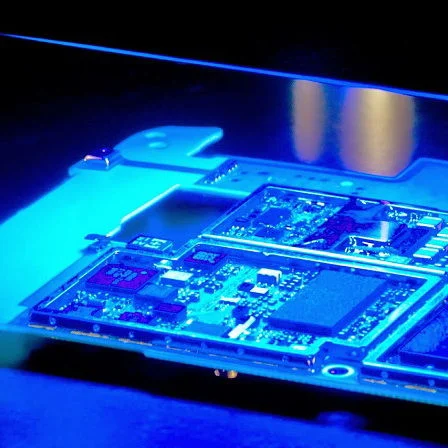
Automated selective conformal coating application using precision robotic system at Weller PCB, ensuring consistent acrylic coating coverage while protecting gold connectors with precise masking
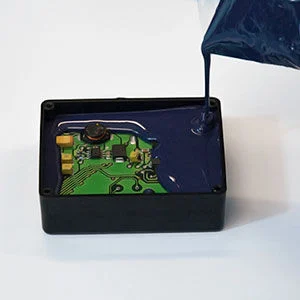
Vacuum-assisted epoxy potting process eliminating air bubbles during encapsulation of automotive sensor module, ensuring complete environmental protection and thermal management for harsh operating conditions.
How to Make the Right Choice: Conformal Coating vs. Potting Resin
When comparing conformal coating and potting resin, it’s helpful to start with what they have in common. Both are typically formulated from organic polymers and cure to form electrically insulating protective layers. Each provides a degree of resistance to chemicals and temperature variations.
The polymer systems used in both protection methods also share similarities, with acrylic, epoxy, polyurethane, and silicone being among the most commonly used chemistries.
To help guide your decision, refer to the comparison table below—an essential tool for selecting the right circuit board protection solution based on your PCB assembly’s requirements.
Item
Conformal Coating
Resin/Potting
Protection
-
+
Weight
+
-
Cost
+
-
Thermal Management
+
-
Rework
+
-
Strees
+
-
Why Choose Weller PCB for Your Potting Needs?
Technical Expertise:
With years of experience in electronic manufacturing, our team possesses deep knowledge of potting material properties and application techniques.
Quality Assurance:
We implement rigorous quality control measures throughout the potting process, ensuring consistent, reliable results for every project.
Custom Solutions:
Whether you require standard potting compounds or specialized formulations, we develop tailored solutions that meet your exact specifications.
Comprehensive Support:
From initial design consultation to final production, we provide end-to-end support for all your potting requirements.
Conclusion
PCB potting resins represent a critical technology for enhancing electronic reliability in challenging environments. By providing comprehensive protection against mechanical stress, environmental factors, and electrical hazards, potting compounds significantly extend product lifespan and improve performance reliability.
At Weller PCB, we combine technical expertise with advanced manufacturing capabilities to deliver potting solutions that meet the highest quality standards. Our commitment to excellence ensures that your electronic assemblies receive the optimal protection they require for long-term success.
Ready to enhance your PCB protection with professional potting solutions? Contact WELLER today at [email protected] to discuss your specific requirements. Our engineering team will provide expert guidance and customized solutions within 2-4 hours of your inquiry.
A graduate of the Electronic Engineering department, with 30+ years of PCB layout experience, focusing on layouts for high-frequency and high-speed circuit boards.