Conformal coating vs encapsulation for electronics is a critical decision for design engineers and product managers developing PCBs for harsh environments. Conformal coating applies a thin polymeric film (25–250 µm) that conforms to board contours, preserving repairability and minimizing weight.
Encapsulation (or potting) completely immerses the assembly in a thick resin (millimeters to centimeters), delivering superior protection against vibration, shock, and moisture ingress. Understanding the trade-offs between conformal coating vs encapsulation for electronics — including thickness, cost, thermal management, and repairability — ensures you select the right PCB protection method for your application.
This guide provides a direct comparison to help you choose.
What Is Conformal Coating in Electronics Protection?
Common Types of Conformal Coatings:
- Acrylic (AR): Easy to apply and remove, offers good moisture resistance.
- Silicone (SR): Excellent flexibility and high-temperature resistance.
- Epoxy (ER): Hard, durable coating with excellent moisture and chemical barrier properties.
- Parylene (XY): A vapor-deposited polymer offering exceptional, pinhole-free coverage.
Advantages of Conformal Coatings:
- Lightweight & Thin: Adds minimal weight or volume, ideal for miniaturized electronics.
- Repairable: Components can be accessed for rework or repair by removing the coating locally.
- Cost-Effective: Generally lower material and application costs compared to encapsulation.
- Process Flexibility: Can be applied via spraying, brushing, dipping, or selective coating.
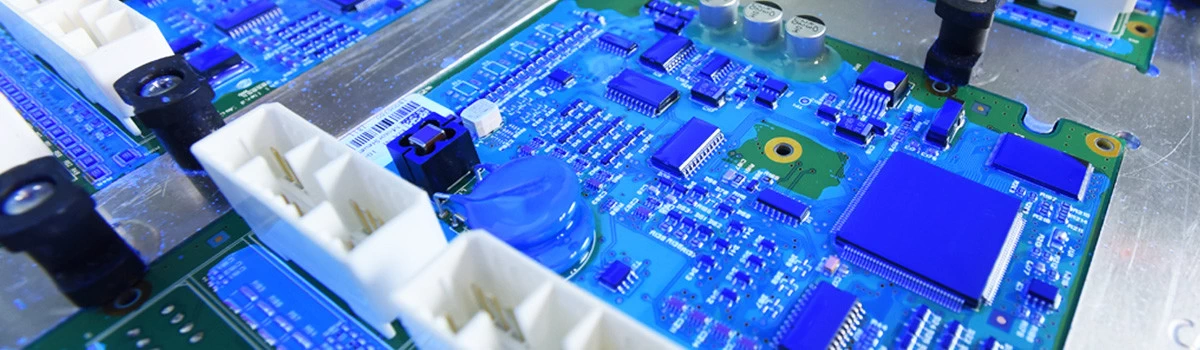
Ideal Applications: Consumer electronics, automotive control units, industrial sensors, and devices operating in humid or dusty environments where repairability and weight are considerations.
What is Potting/Encapsulation in Electronics Protection?
Encapsulation, or potting, involves completely immersing an electronic assembly in a thick, solid or gel-like resin compound within a housing or shell. This creates a rigid, durable, and often permanent protective barrier that offers superior mechanical strength and environmental isolation.
Common Potting/Encapsulation Materials:
- Epoxy Resins: High rigidity, excellent chemical and thermal resistance.
- Silicone Gels/Elastomers: Soft, flexible, and great for stress-sensitive components and thermal cycling.
- Polyurethane Resins: A balance of flexibility, toughness, and moisture resistance.
Advantages of Potting/Encapsulation:
- Maximum Protection: Superior defense against heavy physical impact, vibration, water immersion, and harsh chemicals.
- Excellent Thermal Management: Some compounds enhance heat dissipation away from components.
- High Dielectric Strength: Provides superior electrical insulation.
- Mechanical Stability: Potting compound secures all components, making assemblies highly resistant to shock and vibration.
Ideal Applications: Underwater equipment, automotive modules (e.g., battery management systems), downhole drilling electronics, outdoor LED drivers, and high-voltage power supplies where extreme durability is non-negotiable.

Conformal Coating vs. Encapsulation: A Direct Comparison
Feature
Conformal Coating
Potting/Encapsulation
Thickness & Form
Thin film (25-250 µm)
Thick, solid mass (mm to cm)
Weight Added
Minimal
Significant
Protection Level
Good against moisture, dust, corrosion
Excellent against immersion, shock, vibration, crush
Thermal Management
Limited
Can be enhanced with fillers
Repairability
Relatively easy
Very difficult, often destructive
Cost
Generally lower
Higher material and processing costs
Process Complexity
Lower; automated spraying/dipping common
Higher; mixing, degassing, precise pouring required
Recommended Reading: Antala guide: conformal coating vs potting vs encapsulation differences
Key Factors for Choosing in Full Electronics Manufacturing Services
Selecting the right protection method is a collaborative decision between you and your electronics manufacturing services (EMS) partner. Key considerations include:
Operating Environment:
Will the device face occasional condensation or complete submersion? Is it exposed to fuels, solvents, or constant vibration?
Size & Weight Constraints:
Are you designing a wearable device or a stationary industrial control box?
Product Lifecycle:
Is the product disposable, or will it require field servicing and component upgrades?
Regulatory & Standards Compliance:
Does the product need to meet specific IP ratings, UL standards, or automotive qualifications?
Thermal Requirements:
How much heat do critical components generate, and how must it be dissipated?
Total Cost Target:
This includes material, application labor, rework costs, and potential field failures.
How to Look for Right Supplier for Your Design
For businesses searching for “full electronics manufacturing services,” it’s vital to partner with an EMS provider that offers deep expertise in both conformal coating and encapsulation processes. Look for a manufacturer with:
- Advanced application and curing equipment.
- Material science expertise to recommend the optimal compound (e.g., UV-cure coatings, thermally conductive epoxies,IEC 60664-3).
- The ability to perform pre-coating masking and post-process validation testing.
- Strict process controls for consistency and quality (e.g., IPC CC-830 for coatings).
Conclusion
There is no universal winner in the coating vs. encapsulation debate. The choice is fundamentally driven by your product’s specific performance requirements and operational destiny. Conformal coating offers a repairable, lightweight shield for challenging but not extreme environments. Encapsulation provides a rugged, nearly indestructible fortress for electronics facing the harshest conditions.
The most successful electronic products are built through close collaboration. By clearly communicating your product’s requirements and lifecycle vision to your full electronics manufacturing services partner early in the design phase, you can ensure the selection of the most effective, reliable, and cost-efficient protection strategy. This partnership ultimately guarantees that your product delivers on its promise of quality and durability in the real world.
Reference
- IPC standards for conformal coating and encapsulation:https://www.ipc.org/standards
- IEEE publications on PCB reliability testing:https://www.ieee.org/
- MacroFab: conformal coating vs potting comparison:https://www.macrofab.com/blog/conformal-coating-vs-pcb-potting-encapsulation/
- Fenix MFG coating vs potting comparison:https://fenix-mfg.com/conformal-coating-vs-potting-electronics-protection/
- ELE Times: to coat or encapsulate — informed choice:https://www.eletimes.ai/to-coat-or-encapsulate/