Printed circuit boards (PCBs) are found in almost every electronic product, such as phones, laptops, medical equipment, and factory machines. Understandably, testing of PCBs becomes critical as they become smaller and more complex. Therefore, manufacturers must ensure that every connection and component is functioning before customers use the product. One popular way to check this is called Flying Probe Testing (FPT).
Flying probe testing is a type of automatic electrical test for PCBs. It does not require a special fixture. As a result, it is very useful for checking prototypes, small-quantity orders, and complex boards. Traditional testing methods can be too expensive or not flexible enough for these cases.
What Is Flying Probe Testing?
Flying probe testing uses movable probes to contact the PCB at various points. It verifies the electrical properties of the board. Older methods, such as ICT (in-circuit testing), use a fixed ‘bed-of-nails’ fixture. On the other hand, flying probes can move more freely under computer control.
These probes can access pads, vias, component leads, and test points to measure electrical characteristics such as:
- Continuity
- Resistance
- Capacitance measurements
- Inductance measurements
- Detection of shorts and opens
- Component polarity
This machine does not require a special fixture. Hence, manufacturers can quickly switch to a new PCB design by simply loading a new test program. Flying probe testing is very good for making prototypes and small batch production.
Why PCB Testing Is Necessary
Even a carefully manufactured PCB can contain defects. Generally, problems may arise during solder paste printing, component placement, reflow soldering, or PCB fabrication itself. Common issues include:
These probes can access pads, vias, component leads, and test points to measure electrical characteristics such as:
- Open circuits
- Short circuits
- Missing components
- Wrong component values
- Incorrect polarity
- Solder bridges
- Damaged traces
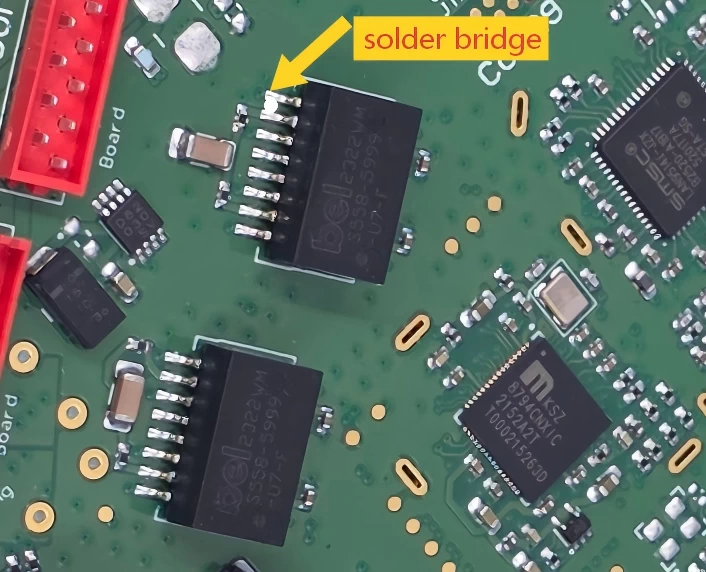
If a PCB has problems, the product might be unreliable, fail, or even pose safety risks. Therefore, testing helps manufacturers find these problems early. Eventually, they can be fixed before customers receive the product.
Some PCB problems cannot be seen with the naked eye. Even if a board looks perfect, it may still have hidden electrical issues. Therefore, electrical testing becomes important.
How Flying Probe Testing Works
Flying probe testing combines mechanical motion, precision measurement, and software automation. The process generally involves several stages.
1. Importing Design Data
The testing process begins with importing PCB design files into the testing software. These files may include:
- Gerber files
- CAD data
- Netlists
- Bill of Materials (BOM)
The software analyzes the PCB layout and identifies test locations and expected electrical connections.
2. Generating the Test Program
After reading the design data, the machine generates a test sequence. This sequence determines:
- Which points will be tested
- The order of probe movement
- What measurements will be taken
- Acceptable electrical tolerances
Modern systems optimize probe movement paths to reduce testing time. Hence, it improves efficiency. Moreover, trajectory planning is important because probe movement directly impacts production speed.
3. Board Alignment
The PCB is aligned before testing. This is done with fiducial marks or reference points. Eventually, proper alignment ensures the probes contact the correct locations accurately, even on densely packed boards.
4. Probe Movement and Contact
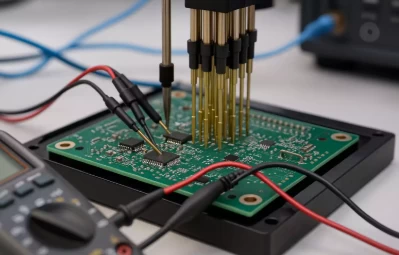
The flying probes can move across the PCB in the X, Y, and Z directions. Some machines use four probes, while others use eight or more. The probes touch each test point and send an electrical signal to test it.
Measurements are then taken to determine whether the circuit behaves as expected.
5. Fault Detection
The machine compares the test results with the design values. If there are differences, the software marks the board for an engineer to check.
Common detected faults include:
- Open connections
- Unintended shorts
- Incorrect resistor or capacitor values
- Reversed diodes or polarized capacitors
- Poor solder joints
Types of Tests Performed
Flying probe systems can perform several kinds of electrical evaluations.
Continuity Testing
Continuity testing verifies that electrical paths are present where they should be. If a trace is broken or improperly soldered, the machine identifies an open circuit.
Isolation Testing
Isolation testing checks whether separate nets are accidentally connected. This helps detect solder bridges and short circuits.
Component Verification
The tester can measure resistance, capacitance, and inductance to verify that installed components match the design specifications.
Polarity Testing
Certain components, like diodes, electrolytic capacitors, and integrated circuits, must be installed with the correct orientation. Flying probe systems can verify polarity and detect reversed components
Power Rail Testing
Some systems apply power to selected sections of the board and monitor voltage behavior to verify functionality.
How FPT Compares with In-Circuit Testing (ICT)
Flying probe testing is often compared with traditional in-circuit testing. That’s because both methods evaluate the electrical integrity of a PCB. However, the two approaches differ significantly.
Feature
Flying Probe Testing (FPT)
In-Circuit Testing (ICT)
Testing Method
Uses software-controlled movable probes to contact different test points sequentially.
Uses a fixed “bed-of-nails” fixture with many spring-loaded pins contacting the PCB simultaneously.
Test Speed
Slower because probes move from point to point during testing.
Very fast since multiple test points are checked simultaneously.
Fixture Requirement
Does not require a custom fixture.
Requires a dedicated custom fixture for each PCB design.
Setup Cost
Lower setup cost because testing is mainly software-based.
Higher setup cost due to fixture design and manufacturing.
Design Changes
Test programs can be updated quickly without additional hardware.
Design changes may require a new or modified fixture.
Initial Deployment Time
Faster to deploy since no fixture fabrication is required.
Longer deployment time because fixtures must be manufactured first.
Accessibility
Small probes can access compact pads and dense PCB layouts effectively.
Accessibility depends on fixture pin placement and the availability of test points.
Flexibility
Highly flexible and easy to adapt to design changes.
Less flexible because fixture modifications are needed for design revisions.
Typical Applications
Prototype validation, R&D, aerospace, medical, and specialized electronics.
Mass production of consumer electronics and long production runs.
Cost Efficiency
More economical for small batches and frequently changing designs.
More economical for large-scale production with stable designs.
Best Production Volume
Suitable for prototype, low-volume, and medium-volume production.
Best suited for high-volume manufacturing.
Main Limitation
Slower throughput for large-scale production.
High fixture cost and lower flexibility.
Advantages of Flying Probe Testing
Flying probe testing offers several important benefits.
Lower Setup Cost
One of the biggest advantages is the elimination of custom fixtures. ICT fixtures can be expensive, especially for complex boards. Conversely, flying probe systems rely primarily on software. Hence, it significantly reduces initial setup costs.
Flexibility
If the design changes, the test program can be updated quickly. So, the flying probe system can easily follow the new PCB. This is very helpful during development because the PCB layout often changes.
High Accessibility
Small probes can reach tight spots and small pads more easily. Therefore, flying probe testing is suitable for modern miniaturized electronics.
Improved Test Coverage
Probes can touch component pins and hidden test points, making it easier to find mistakes.
Non-Destructive Testing
Flying probe testing is non-destructive. The machine evaluates electrical characteristics without damaging the PCB or components.
Faster Product Development
There is no need to wait for a fixture. Hence, testing can start soon after PCB fabrication. This helps development move faster and makes debugging quicker.
Suggested Reading: Box Build Assembly Guide for OEMs & Electronics Designers
Limitations of Flying Probe Testing
Despite its advantages, flying probe testing also has limitations.
Slower Test Speed
Because the probes move to each point one by one, testing is slower than ICT. For large production runs, this is not ideal.
Limited High-Volume Efficiency
ICT is more economical for mass production involving thousands of boards. Even though there are higher fixture costs, a faster throughput makes it more economical.
Mechanical Complexity
A flying probe machine needs very accurate movement. If it moves too fast, it can be hard to keep the correct position.
Accessibility Constraints
Some densely populated boards may still contain areas difficult for probes to reach safely.
Advanced Features in Modern Flying Probe Systems
Modern flying probe machines include advanced capabilities beyond basic continuity testing.
High Voltage Stress Testing (HVS)
HVS applies higher voltages to detect insulation weaknesses and hidden defects that might not appear under normal conditions.
Micro-Short Detection
Very small shorts between adjacent conductors can be difficult to identify. Advanced flying probe systems use sensitive detection methods to locate these defects without damaging the PCB.
Optical Inspection Integration
Some systems combine flying probe testing with automated optical inspection (AOI). For instance, cameras inspect component placement and solder quality while electrical tests verify functionality.
Design Considerations for Flying Probe Testing
PCB designers often modify layouts slightly to improve testability.
Test Point Placement
Accessible test points make it easier for probes to contact circuits reliably. Designers typically provide exposed pads or vias for important nets.
Board Support
Thin or flexible boards may require support fixtures to prevent bending while probes apply pressure.
Additionally, design for testability has become an important aspect of modern PCB engineering, as good test access reduces manufacturing issues and simplifies debugging.
Suggested Reading: Top 10 DFM Issues that Affecting PCB Manufacturing
The Future of Flying Probe Testing
As PCB complexity continues to increase, flying-probe technology is evolving as well. Modern boards feature:
- Smaller components
- Higher signal speeds
- Greater layer counts
- Tighter spacing
To address these challenges, manufacturers are improving probe accuracy, optimizing motion, and automating data analysis. In this regard, artificial intelligence and machine learning can help future systems identify defects more efficiently.
Moreover, researchers are actively developing faster trajectory-planning algorithms and improved inspection integration to reduce testing time while maintaining accuracy.
Recommended Reading: How AI & Automation Are Transforming PCB Manufacturing
Conclusion
Flying probe testing has become an essential tool in PCB evaluation because it combines flexibility, precision, and relatively low setup cost. For example, manufacturers can efficiently test prototypes and low-volume PCB assemblies with moving probes. More importantly, they can maintain high defect-detection capability at all times.
Although flying probe testing is slower than traditional in-circuit testing, its adaptability makes it highly valuable for modern electronics manufacturing, especially where PCB designs change frequently or production quantities are limited.
Reference
- “Flying probe test: An extensive guide to the technology and applications,” Wevolver. https://www.wevolver.com/article/flying-probe-test-an-extensive-guide-to-the-technology-and-applications
- “The ultimate guide to flying probe test in PCBA,” Alumina PCB. https://aluminapcb.com/the-ultimate-guide-to-flying-probe-test-in-pcba/
- “Flying Probe Test,” Electronics Notes. https://www.electronics-notes.com/articles/test-methods/automatic-automated-test-ate/ict-in-circuit-test-flying-probe.php
- “How flying probe testing works for PCB assembly” Sierra Circuits Blog. https://www.protoexpress.com/blog/how-flying-probe-testing-works-for-pcb-assembly/