Designing a PCB is one of the many processes included in delivering a reliable electronic product to the users. So, as a designer, you may have a top-quality product, ready to launch in the market, but it’s only as good as the way it finishes in the market. Box Build Assembly is all about how your product looks to the end user.
When you’ve done all the hard work, such as designing the perfect circuit board layout, selecting the right components, and picking the perfect enclosure, it’s now time to answer the dreaded question: Should you assemble everything yourself, or look for an electronics manufacturer that does the job for you?
With box building assembly, designers’ queries are answered. Whether it’s electronics, wiring, mechanics, enclosures, or product testing, box building provides a comprehensive roadmap for everything. This article will explore what you need to know about Box Build Assembly.
What Is Box Build Assembly?
Box Build Assembly is also called System Integration or electromechanical assembly. It’s a combination of several aspects like mechanical, electronics, and wiring of components. In addition to that, Box Build Assembly turns the design into a complete ready-to-use product.
A typical box build assembly process starts after PCB assemblies and testing procedures. It means that the boards must have gone through compliance testing for standards, after which they are installed into enclosures and connected with other components. It means that a box builds assembly can include wide-ranging components like batteries, cables, harnesses, heat sinks, fans, etc., essentially anything and everything that is needed to make the product ready-to-use.
The WiFi router is the most typical and easiest-to-understand example of Box Build Assembly. It’s circuit board is housed in a strong and durable plastic enclosure. Once the router PCB is populated with electronic components, batteries, etc. and tests, the box build assembly takes over.
The populated circuit board (PCBA) is installed into the enclosure and further connected with parts like:
- Router antenna
- Power connector
- Ethernet ports
- LED indicators
- Heat sinks
Later, firmware packages may also be installed to ensure that the product is fully assembled and available for the end user.
So, wherever electronic products are in use, it’s because of box build assembly. So, whether it’s robotics, consumer electronics, industrial controls, medical equipment, automotive or IoT applications, you will find box build assembly everywhere.
Box Buils allows Original Electronic Manufacturers (OEMs) to outsource complete product integration to a contract manufacturer, reducing internal assembly burdens and improving time-to-market.
Key Elements of Box Build Assembly
Since box build assembly combines multiple electronic and mechanical elements to transform PCB assemblies into a complete, ready-to-use product, the requirements for each product can vary by application. There are several core elements are commonly included as summarized in the following table:
| Box Build Element | What It Includes | Purpose |
|---|---|---|
| Printed Circuit Board Assemblies (PCBAs) | Single or multiple assembled circuit boards, interconnected boards, mounted electronics | Forms the electronic core of the product and performs its primary functions |
| Enclosures and Mechanical Integration | Enclosures, chassis, brackets, standoffs, fasteners, covers, seals | Provides structural support, protection, proper fit, and durability |
| Cable Harnesses and System Interconnections | Cable assemblies, wire harnesses, connectors, power and signal routing | Connects internal components and enables reliable communication and power distribution |
| Power, Thermal, and Electromechanical Components | Power supplies, transformers, fans, heat sinks, sensors, motors, filters | Supports power delivery, thermal management, and additional mechanical functionality |
| User Interfaces and External Connections | Displays, switches, buttons, LEDs, ports, external connectors | Enables user interaction and external device connectivity |
| System-Level Testing and Calibration | Functional testing, burn-in, environmental testing, calibration | Verifies complete product performance and reliability before shipment |
| Labels, Packaging, and Documentation | Prepares the finished product for deployment, traceability, and delivery | Product labels, serial numbers, compliance markings, packaging, manuals, and firmware loading |
Recommended Reading : From Plastic Enclosure to PCB: Full-Scale Electronics Manufacturing Solutions
Box Build vs PCB Assembly
Box-build assembly and PCB assembly are often related. However, the major difference lies in the output and the scope of each assembly process.
Printed Circuit Board Assembly (PCBA) focuses on mounting the components on the designed circuit board. It’s a system-level integration that results in a functional PCB, which is then tested through various techniques. In PCBA, there is minimal mechanical work, as most of it involves placing and soldering components on the board. Once the assembly is done, it is ready for the next stage of production.
Box Build Assembly focuses on integrating the fully functional PCBA into the system. It relates to system-level integration where mechanical enclosures, hardware, safety, power supplies, and firmware are added to the final product, which is then forwarded to product-level testing and packaging. The scope of Box Build Assembly is to deliver a finished product that the user can work with.
Recommended Reading: How to Design PCBs for Easy Assembly: Avoid Common DFM Mistakes
Box Build Assembly Process
Box build assembly is a structured process that transforms a product concept into a fully assembled and tested system ready for deployment. Different products can have different aspects of assembly procedures, but most box build workflows follow this template:
1. Defining Requirements and Planning
A Box build process starts with the product’s technical requirements. Designers evaluate the functionality, specifications, and enclosures needed for the product. This is a critical phase involving continuous coordination between the manufacturer and customers to ensure they are well-aligned to deliver the product goals. Moreover, key elements like performance expectation and compliance requirements are also discussed at this stage.
2. Prototyping and Component Preparation
The finalized designs are validated through prototyped units. This stage allows the manufacturers to address any design issues, refine the layouts and confirm that components fit properly. As a result, it evades any mishaps during the volume production. Moreover, the PCB components, hardware, wiring, and mechanical hardware are sourced and inspected to ensure that they meet the quality standards.
3. Assembly and Mechanical Integration
This stage focuses on the installation of PCBAs into the enclosures. Technicians install and integrate the PCBAs, mounting, securing, and connecting all the electrical and mechanical hardware together. Typically, this stage includes:
- Mounting boards and securing hardware
- Routing cable assemblies and wire harnesses
- Installing connectors, power components, and cooling elements
Furthermore, essential software or firmware is also loaded into the hardware if needed.
4. Initial Power-On and Functional Testing
This step involves testing the product. After assembly, the product is initially tested for power-up and functional testing. It verifies that all major functions operate correctly before advancing to final validation.
5. Quality Control and System-Level Testing
Once the product clears the initial functional testing, it moves to further comprehensive inspection and testing procedures. These procedures may include:
- Electrical checks
- Visual inspection
- Thermal analysis
- Burn-in or environmental stress testing
The testing phases ensure that the product is market-ready.
6. Packaging and Documentation
The tested and approved product is then labeled, packaged, and prepared for shipment. This stage focuses on build records, test reports, and technical documentation to ensure traceability at later stages.
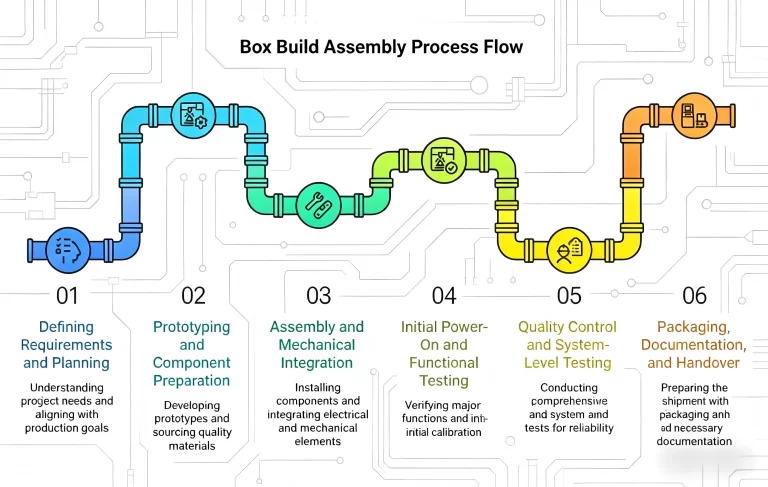
By combining careful planning, integration, testing, and final preparation, box build assembly delivers a complete, production-ready product rather than just an assembled circuit board.
Benefits of Box Build Assembly for OEMs
For OEMs, Box Build Assembly can simplify production by streamlining critical processes. As a design company, you won’t need to worry about setting up production lines. Here are some key benefits of Box Build Assembly.
1. Simplified Supply Chain
Box build simplifies the supply chain because OEMs won’t need multiple vendors for each process. PCB assembly, cable management, and mechanical assembly are all handled through one partner. In a way, it reduces the complexity of the system.
2. Faster Time-to-Market
Thanks to an integrated manufacturing process, there are fewer delays between production stages, and the overall product finishes sooner. Hence, it allows manufacturers to market the product more quickly. Especially in a competitive market like China, the reduced time to market can be a game-changer for electronic manufacturers.
3. Reduced Manufacturing Cost
When you deal with one partner, it reduces the overall cost of your product. Moreover, it cuts down the overheads, labor costs, logistics, and rework expenses because the box build partner takes care of everything.
4. Quality of Products
Box build assembly works on standardized procedures and testing methods. Therefore, the product quality is reliable and traceable. Process documentation helps in ensuring consistency and quality control.
Suggested Reading: How AI & Automation Are Transforming PCB Manufacturing

Common Box Build Applications
Box Build Assembly is found virtually everywhere in electronics. Here are some key areas that use the power of box build assembly.
Industrial Electronics
Industrial systems often require complex assemblies. Systems like control cabinets, PLC systems, HMIs, and sensor modules are a mix of sophisticated electronics and mechanical hardware that require precise positioning and mounting. Therefore, box build assembly is widely used in this sector.
Medical Devices
Medical electronics is too critical when it comes to the placement of components. Such assemblies require
- Precision assembly
- Traceability
- Regulatory
- complianceExtensive testing
Thanks to rigorous box build processes, it’s easy to deploy, test and trace the products when needed.
Robotics and Automation
Robotics and automation provide a classical mix of mechanical and electronics, so box build assembly is a no-brainer in this sector. In robotics, box build assembly often includes:
- Controllers
- Motor drives
- Wiring systems
- Mechanical integration
All of these components are perfect candidates for box build assembly
When to Use Box Build Assembly?
For OEMs, Box build Assembly is ideal when:
- Products involve multiple integrated subsystems
- Internal assembly resources are limited
- A faster time-to-market is needed
- Product quality and testing are critical
- Supply chain simplification is a priority
Conclusion
Box build assembly is a step further ahead of PCBA as it transforms a design into a working product. As more complex products continue to populate the market, box build assembly makes it easier for manufacturers to design, deploy and market their product faster in a competitive market.
References
- Versae Electronics, “Box Build Assembly Guide,” Versae. Accessed: [Online]. Available: https://versae.com/box-build-assembly-guide/
- Cadence, “What is a Box Build Assembly?,” Cadence PCB Design & Analysis Blog. Accessed: [Online]. Available: https://resources.pcb.cadence.com/blog/what-is-a-box-build-assembly
- WellPCB, “Box Build Assembly: Definition, Components, Process and Benefits,” WellPCB Blog. Accessed: [Online]. Available: https://www.wellpcb.com/blog/cable-assembly/box-build-assembly-guide/
- Cablepoint, “What is Box Build Assembly?,” Cablepoint Blog. Accessed: [Online]. Available: https://www.cablepoint.co.uk/blog/what-is-box-build-assembly/
- LSTPCB, “Steps and Advantages of Box Build Assembly,” LSTPCB News. Accessed: [Online]. Available: https://www.lstpcb.com/news/steps-and-advantages-of-box-build-assembly/