Introduction
Reliability is a critical requirement in modern electronics. More than just being a desired outcome, it has transformed into an essential element to ensure quality and continued operations in industrial control, automotive systems, and consumer electronics. Because when a printed circuit board fails, ot’s consequences can be far-ranging, which causes a headache for manufacturers and production companies.
When a product fails at the PCB design level, it’s not just the failure of one device. Instead, it disrupts the entire assembly line. Therefore, the cost of a failure is much more severe, calling for regulatory consequences, damage to the manufacturer’s reputation, and a dip in brand value. It effectively means one thing: Manufacturers need to shift focus from solely final-stage inspection and invest more in sophisticated testing mechanisms.
Modern-day electronic testing has evolved from final checkpoint testing into an integrated process that runs with the product through its design stages. From conceptual design to fabrication to assembly, these testing methods ensure that the defects can be duly caught and removed before products go into the packaging and deployment phase.
This article is all about reliability testing methods and how it offers advantages to original equipment manufacturers.
What Is Integrated Testing in PCB Manufacturing?
Integrated testing in PCB manufacturing assures quality in PCB products. It combines multiple testing and inspection methods that are spread out across the product lifecycle, starting from initial design through fabrication, assembly, and final validation.
As compared to traditional end-of-line testing, integrated testing methods offer a proactive approach to catching defects during the production phase. So, the product operation and reliability aren’t tested only after a board is fully assembled. This approach identifies issues promptly, allowing cheaper rework and addressing design flaws in embedded products.
There are different stages in integrated testing. Each stage has a different approach, embedding verification at every critical stage, including:

1. Design Verification
The first stage is the design verification stage. This phase ensures that the proposed PCB design meets the requirements, such as trace width, component placement, current and voltage requirements, etc. Design verification involves more than one tool, such as:
- Design Rule Checks (DRC) – Verifies spacing, routing, and manufacturability rules. The process evades any chances of shorts and fabrication defects.
- Signal Integrity Analysis – identifies signal integrity issues like crosstalk, timing issues, and noise in high-speed circuits.
- Thermal simulations – these simulations can predict risks attached to hotspots and overheating.
- Design for Testability – DFT tests ensure that the PCB can be inspected and tested at the later stages. Usually, testability is checked by adding test points in the PCB.
This critical stage ensures all the requirements are met before the PCB goes into the fabrication stage.
Suggested Reading: Top 10 DFM Issues that Affecting PCB Manufacturing
2. In-Process Inspection
In-process inspection catches any defects and issues in real time as the product moves through the production phase. For example, Automated Optical Inspection (AOI) is used to detect any product defects through visual inspection. This process uses high-resolution cameras and software that inspect visual defects.

For instance, such an inspection can detect solder bridges, polarity errors, incorrect solder deposition, missing PCB components, misaligned parts, bad solder joints, and many similar issues. So, imagine a resistor is placed incorrectly on a PCB.

The AOI process will detect and report the issue before the PCB is forwarded into the functional testing phase. It reduces the rework process and simplifies the overall production line, particularly in high-volume manufacturing.
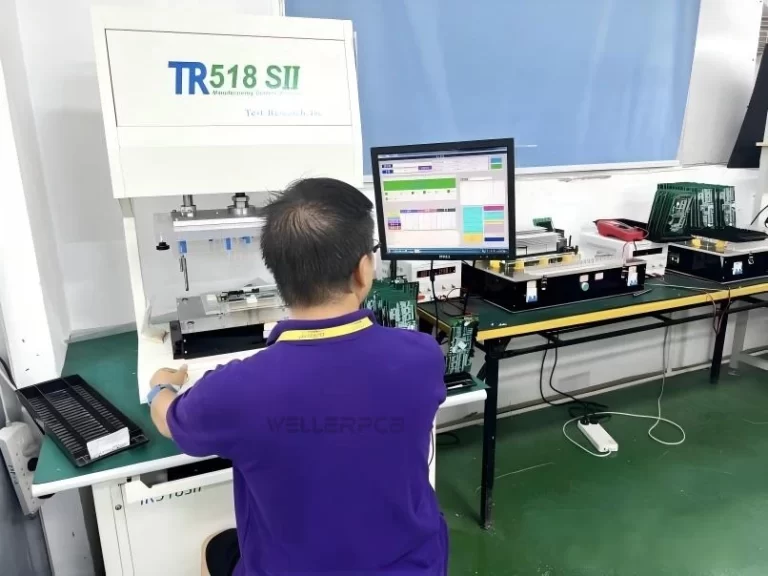
3. In-Circuit Testing
In-circuit testing refers to the verification and testing of the electrical integrity of the PCB. This testing method includes various board checks, such as:
- Open circuits
- Shorts
- Incorrect component values
- Faulty components
- Connectivity problems
In-circuit testing uses bed-of-nails fixtures or flying probes. It verifies whether assembled circuits meet electrical expectations. For example, a resistor that visually appears correct may have the wrong value installed. AOI might miss it, but ICT can catch it.
4. Functional Testing
Functional testing ensures that the board performs as expected. The assembled PCBs are verified and tested in the operating conditions. While ICT checks individual circuits on the board, functional testing verifies the overall behavior of the circuit.
Generally, functional testing may check boards for:
- Power-up sequences
- Communication interfaces
- Sensor responses
- Load conditions
- Application-specific performance
For instance, a motor controller board may be tested under actual control loads to confirm proper response behavior.
As a result, functional tests can predict how a PCB may perform in real-world scenarios before products are shipped.

Both ICT and FCT are essential, but they serve different purposes. The table below summarizes their key differences to help you choose the right strategy for your PCBA program.
Table 1: Key Differences Between In-Circuit Test (ICT) and Functional Test (FCT)
Comparison Dimension
In-Circuit Test (ICT)
Functional Test (FCT)
Primary Objective
Verify component-level electrical integrity (resistance, capacitance, opens, shorts).
Validate system-level behavior under simulated operating conditions.
Test Coverage
Individual components, solder joints, and basic connectivity.
Full circuit function, signal flow, power-up sequence, I/O communication.
Power Applied to Board
Typically no (or very limited power) — board is tested in unpowered state.
Yes — board is powered on and operated as in final application.
Test Equipment
Bed-of-nails fixture or flying probe tester.
Custom test fixture, signal generators, data acquisition modules, often with a PC controller.
Typical Defects Found
Wrong component value, missing component, short circuit, open solder joint, polarity error.
Incorrect timing, failed communication interface, unstable output under load, wrong response to input.
Speed (per board)
Fast (a few seconds to under a minute) for bed-of-nails; slower for flying probe.
Slower (seconds to minutes) because full functional sequence must run.
Fixture Cost
High for bed-of-nails (custom fixture per PCB); lower for flying probe (no fixture).
Medium to high — requires custom interface and sometimes simulation hardware.
When It Is Performed
After soldering (post-reflow/wave), before functional test.
After ICT, as the final electrical test before conformal coating or shipping.
Failure to Detect
Cannot verify that the circuit works as a system (e.g., timing, firmware interaction).
May not pinpoint the exact failed component; requires additional diagnosis.
Best Suited For
High-volume production with stable design; detecting manufacturing process defects.
Low-to-medium volume, complex mixed-signal boards, or safety-critical applications.
Recommended Reading: Avoid Costly SMT Errors: Essential PCB Layout Guidelines for DFM Success
5. Reliability and Environmental Stress Testing
Environmental testing relates to the long-term durability of the PCBs. This is the final testing phase where the board undergoes various mechanical, thermal, and environmental stresses. Some of the common tests include:
- Temperature Cycling – continuous and repeated heating and cooling cycles to test temperature response in terms of solder fatigue and material weakness.
- Vibration testing – Boards are exposed to mechanical stress, to observe behavior, especially in industrial, aerospace, and automotive applications.
- Burin-in Testing -Rigorous operation under extreme conditions to test for early-life failures.
Thanks to a layered testing strategy, any defects or flaws in the PCBs can be duly detected and negated. Hence, the process reduces long rework times, reduces cost, and improves product efficiency.

Recommended Reading: From Prototype to Mass Production: Best Practices for Smooth NPI in PCB Design
How Integrated Testing Helps in Different Industries
Product reliability is a critical feature in commercial production sectors. Especially in the modern age, where most systems run on electronic boards, PCB failure can be devastating for businesses. The following table highlights some major industrial sectors where PCB reliability is highly critical:
Industrial Sector
Application
Consequence
Automotive Electronics
Heavily relies on electronics for braking systems, battery management, ADAS, and sensor data management.
Failure of electronics in the electronic systems can compromise safety and performance.
Medical Electronics
Patient monitoring systems, infusion pumps, and diagnostic systems require highly reliable electronics
Failure of electronics can disrupt accurate patient data, which can be critical.
Industrial Controls
Robotics, factory automation systems, and control systems depend on electronic boards
Failure can result in loss of control and feedback mechanisms, which could lead to downtime in production lines.
Aerospace Systems
Defence and aerospace systems use high-performance PCBs that can last in extreme altitudes and environmental conditions
Failure in electronics can be mission-critical.
Benefits of Integrated Testing for OEMs and Manufacturers
For original equipment manufacturers (OEMs), integrated testing offers several operational and financial advantages. Here is a quick look:
- Improved Reliability – The output products are more reliable due to rigorous testing and multiple layers of validation.
- Fewer Repairs and Warranty Costs – When PCBs are tested at each production stage, the final product is less prone to errors, which reduces warranty and repair costs.
- Faster Time to Market – Since most issues are handled during the production phase, there are fewer delays after launch, and it improves the time to market.
- Compliance with Regulations – Integrated testing allows manufacturers to adhere to the compliance standards set by global bodies like ISO quality systems, IPC standards, etc.
Emerging Trends in Integrated PCB Testing
As integrated testing continues to evolve, it will directly impact product reliability in most industrial sectors. The following table highlights the key emerging trends in integrated testing.
Technology
Trend
Machine Learning
AI-Driven inspection for improved accuracy and reduced false calls in AOI.
Digital Twins
Use of virtual models to simulate the physical behavior of the product before being actually tested in the real world
Automated Analytics
Advanced analytics can process trends for predictive quality control
Industry 4.0 Integration
Integrating smart manufacturing equipment to process data, automate closed-loop quality control and support predictive reliability.
Suggested Reading: How AI & Automation Are Transforming PCB Manufacturing
Conclusion
Integrated testing is a lifesaver for manufacturing businesses. Since the PCB design process is such a complex mix of versatile stages, the integrated testing method allows you to address design and functionality issues at the right moment. The process involves functional, design, and optical testing to reduce downtime and rework costs for manufacturers.
As PCB complexity continues to increase, integrated testing methods equipped with the latest technologies, such as Artificial Intelligence, will enable designers to streamline their processes and improve product reliability.
For advanced electronics manufacturing, the future of reliability is not testing more at the end—it is testing intelligently throughout the entire product lifecycle.
References
1.”What Is In-Circuit Testing? An Essential Guide for Engineers,” Wevolver, [Online]. Available: https://www.wevolver.com/article/what-is-in-circuit-testing
2.”Why AOI and Quality Control Matter in PCB and Flex PCB,” PICA Manufacturing, [Online]. Available: https://picamfg.com/why-aoi-and-quality-control-matter-in-pcb-and-flex-pcb/
3.”Complete Guide to PCB Reliability Testing: What Makes a Board Truly High Quality,” PCBGogo, [Online]. Available: https://www.pcbgogo.com/Article/Complete_Guide_to_PCB_Reliability_Testing__What_Makes_a_Board_Truly_High_Quality_.html
4.”A Guide to Bare-PCB Testing Methods for Reliable Circuit Boards,” Arshon Technology, [Online]. Available: https://arshon.com/blog/a-guide-to-bare-pcb-testing-methods-for-reliable-circuit-boards/
5.”Reliability Test Matrix PCB: Complete Guide to Validation,” APTPCB, [Online]. Available: https://aptpcb.com/en/blog/reliability-test-matrix-pcb
6.The Implementation of Design Reliability Testing and Risk Reduction Strategies,” Cadence Resources, [Online]. Available: https://resources.pcb.cadence.com/blog/2019-the-implementation-of-design-reliability-testing-and-risk-reduction-strategies